There was a guy in my class in middle school whom I remember vividly. He skipped many classes, and in the classes he did attend, he slept through most of them. Every now and then, he would wake up from his nap and speak out of turn. He would often question what the teacher was saying and offer a different perspective, often forcing the teacher to defend his or her position. He was quick-witted and sometimes even managed to outwit the teacher. He was also unpredictable; you never knew what would come out of his mouth. On top of that, he was charming. It was impossible not to like him. Although he was, in many ways, the teacher’s biggest nightmare and did pretty much whatever he wanted, he managed to charm the teachers to the point where he could always talk his way out of trouble. Even if he hadn’t done the homework and everyone could tell, he somehow managed to save the situation thanks to his quick wit and his ability to think on his feet. Although he had one of the sharpest minds in the classroom, he ended up with the worst grades. I’m not even sure he received grades in every subject. He didn’t seem to care if he did or not; It didn’t matter to him. I remember him vividly because there was one question that kept popping up in my head every time I saw him at school:
How can someone so intelligent be so stupid?
The idea for this post came to me when I had a conversation with a group of friends about the difference between being smart and intelligent. I was surprised by how many people used them interchangeably. I was trying to argue that a person can be smart but not intelligent, and intelligent but not smart.
I had hoped for an intellectual conversation, but that wasn’t what it turned out to be. No one agreed with my definitions of the words, and when I asked them to elaborate on why they disagreed, I was left with the impression that they just had not fully grasped what I was trying to convey. Ever since that conversation, I have asked people in real life and searched online for answers. What is the difference between being smart and intelligent? How do people define these words? I have encountered so many disparate definitions that I wouldn’t know where to begin. However, this post is not about semantics, because most people would be bored to death by that discussion. Let’s change the focus to something that most people can relate to:
Grades.
When I started school, I was one of the top students in every subject. I was a favorite of the teachers. I have always loved learning new things. I was genuinely interested and curious, listening intently to everything the teachers said. I didn’t want to miss anything, and all subjects were easy for me. I was one of those students who never had to put in any effort. I never practiced spelling: I saw the word once and that’s all it took for me to memorize it. At every parent-teacher meeting, I was showered with praise. No teacher ever had anything bad to say about me. It made me feel flawless. It was important for me to be that as well, because I built my identity and self-worth around it. A bad performance didn’t mean the performance was bad: it meant that I was bad. I wanted to be infallible. There was a guy who made a list of the people he hated the most in my class. I was at the top of that list. This is the only time in my life I’ve ever known someone to hate me. His reasoning was this: If I was disappointed in myself for making one mistake, how was he supposed to feel about himself when he hadn’t even passed the test? He had seen how I treated myself after one mistake, and it had made him feel terrible about himself. My high ambitions made him hate me because I had made him shrink.
But my high ambitions weren’t really the problem.
I wasn’t disappointed because I had made one mistake: I was disappointed because I had set a goal and hadn’t reached it.
He hated me because he had compared himself to me.
I wasn’t quite sure how to handle the situation. When I found out about the list, I felt terribly ill—I had stomach pain for days. Just the thought of someone hating me caused me so much distress. I spent a lot of time pondering how other people perceived me and how I wanted to be seen. I wanted people to like me, but I also wanted to stay true to myself. I had set high goals because I was trying to challenge myself; I wanted to make myself work harder. What was I supposed to do? Diminish myself—have lower ambitions—so others wouldn’t feel bad about themselves? I decided in that moment that if my high ambitions made me unlikable, then to hell with being liked. I’m not going to be less than what I am just to be liked by others. It is not a price I’m willing to pay.
I continued to expect a lot from myself and pursue ambitious goals. When we reached the age at which we began receiving grades, my goal was to earn the highest grade in every subject. The first real blow came when I was only given an average grade in physical education. My ACL injury prevented me from participating fully in physical education. When I asked why I was only given an average grade, the teacher told me that, since I hadn’t been able to complete every assignment, he couldn’t give me a higher grade. I thought it was unfair. What was I supposed to do about my situation? It wasn’t like I had injured myself to get out of class. It felt like giving a blind person an F in an art class. I didn’t think the letter on the paper accurately reflected reality. I mean, I was an athlete; sports were my thing. The second blow came when I only received an average grade in music as well. I was in a music-focused program that required an audition for admission. In choir, I was one of the strongest singers. Other students would often stand near me so they could stay on pitch. When I asked the teacher what I was doing wrong, what I needed to improve, she couldn’t really give me a straight answer; she just told me to keep doing what I was doing. For someone who had built an identity around excelling, receiving average grades in some of my strongest subjects was a difficult reality to accept.
In Swedish class, we had a substitute teacher who praised me every chance she got. She raised my grade to the highest mark. But when the regular teacher returned, he wasn’t nearly as impressed with my writing and lowered my grade again. However, when our final grades were issued, I had performed so well on the national Swedish exams that he was forced to raise my grade to the highest mark. It felt as though he did so reluctantly. There were two things that particularly caught my attention when we started receiving grades. First, two teachers could look at the exact same work and arrive at completely different conclusions. One thought my writing deserved top marks; the other lowered my grade as soon as he returned. It was my first realization that grades were far less objective than I had assumed. Second, students let grades define their intelligence. Those who hadn’t received good grades felt stupid, and the ones who had received good grades displayed them ostentatiously. As if the grades had become a part of their identity—the foundation upon which they built their self-worth.
I was terribly disappointed with my grades because I felt as if they didn’t reflect my abilities. They didn’t do me justice. There was a girl in my class who once asked me about my grades. When I told her, she immediately blurted out, “Oh my God, I am smarter than Louise!” She saw being smarter than me as an accomplishment in itself. The fact that she had received better grades than I had was, to her, proof of it.
In my first year of high school, I moved to another city to attend a sports-focused high school. I had decided to give up my dream of becoming a singer and instead devote all my time to my sport. Not everyone agreed with that decision since the odds of making a full recovery from my ACL injury were not in my favor. Even a year after the surgery, the outlook was gloomy. During one of the first indoor handball workouts, I twisted my knee slightly and had to return to the physiotherapist. Through the school, I was treated by one of the best physiotherapists in the region, who also worked for Frölunda. Getting to visit their training facilities was pretty cool. My physiotherapist cared a lot about me and gave me great support as I was growing weary. The knee was so swollen I couldn’t wear jeans and I had to do rehab twice a day. It was challenging both mentally and physically because, by that point, I had expected to be back on the court at full strength. It was the first time the thought had crossed my mind that I might not play again. The school was great in so many ways—their support for both my mental and physical health was invaluable. I had a great handball coach, CK. Although I was too injured to play handball the first semester, he always came down to the gym to give me some encouragement. He also told me that I had nothing to prove to him and I needed to take my time to get whole again. He cared for me. He truly did.
I was in a class filled with athletes from all kinds of sports. I wasn’t used to being in a class where I was one of the few students with serious academic ambitions alongside ambitions in sports. Unfortunately, this was reflected in the teaching and learning environment in the classroom. I remember one test specifically when a group of students was joking and comparing who had gotten the lowest grade. When we received our final grade for the year, I still had the same feeling as the previous year: that I had not reached my full potential and that the grades didn’t do me justice. In psychology, I had become close to my teacher. I could sit in his office and just talk about anything. I had earned top marks on every assignment throughout the year, but for the final assignment we were supposed to do an oral presentation for approximately twenty minutes. I only received an average grade because I had looked down at my papers too much and had made too little eye contact with the audience, which ended up lowering my grade. My shyness had lowered my grade from an A to a final B. It didn’t matter that I had received top marks on all other assignments throughout the semester, the fact that I hadn’t penetrated the souls of my audience lowered my grade in total. I was furious, I refused to talk to my teacher after I found out. The girl I had given the presentation with, who was not as shy as I was, had received an A. She had received average grades throughout the semester, but her A on the final presentation left us with the same final grade. I decided in that moment that the Swedish grading system sucked.
In math, we had a teacher who I wasn’t quite sure was qualified to be a teacher. He could spend half the class writing out an equation on the whiteboard, and then after some moment of pondering, wipe everything off the board and tell us to forget all about it. Halfway through the semester, he received so many complaints that the school had to replace him. They replaced him with an engineer who was great at math but maybe not as great at teaching.
I never recovered in math.
In my second year of high school, I moved back to my hometown and started at a new school. This could be one of the best decisions I have ever made. The school was excellent. Both the teachers and the students were great. It was so inspiring to have intellectual conversations in the classroom with so many ambitious students. Everyone was also friends with everyone, which created a relaxed atmosphere in the classroom. I had decided that this year was going to be the year when I finally reached out to my full potential and earned the highest grade in every subject. At the end of the semester, I was sitting in the office of my history teacher when he told me that I was getting an average grade in history. When he said the words, it sucked the air out of my lungs. I felt as if I wasn’t good enough. I felt stupid, as though I had failed myself. I wanted to throw my academic ambitions down the drain. I was utterly crushed. The next class was Swedish, and we were going to receive our grades in that subject as well. On the break between classes, I hid in the bathroom, trying to remove any sign of distress from my face. But when we came into the classroom and sat down, I just couldn’t keep it in anymore. The tears flooded out of me. My classmates gathered around, trying to console me, but I was inconsolable. My teacher had noticed me and decided to talk to me first. When I sat down next to her outside of the classroom, she asked me what had happened. I looked at her and there was just something about her that made me feel as if I were in a safe place—so I just let it all out. I opened up and told her about everything. About the situation at home, at handball, at school. It was such a cathartic release. She told me something that has stayed with me ever since.
She told me she had never met a student who was performing so well in school while simultaneously dealing with so much outside of it. The reason why I couldn’t see how well I was performing was that I was constantly comparing myself to other people. I saw my classmates earning top grades and wondered why I wasn’t as good as they were. But we all have different circumstances in life and different starting points. Just because I didn’t reach my goal, didn’t make me a failure. Failing means giving up. Sometimes you just need to readjust and set new goals. She also told me that she was not going to give me a top mark in Swedish class either—only a B—but she was certain that the following year, I would receive one. When we came back after the summer, we found out that she had resigned. She was right, though.
The following semester, I came back to school with a new goal: to ease the pressure I placed on myself and simply do the best I could given my circumstances. It was the key to success. In my final year, I earned the highest grade in 11 out of 13 subjects. By the standard of my new goal, it was a success.
It had been a tough final year as well; I combined studies with a high-level athletic career. One day at school, one of my friends, probably one of the brightest students I have ever met, shoved me into the bathroom and locked the door behind us. The same bathroom I had locked myself into just six months earlier. She sat in the same place as I had, with tears flooding out of her just as mine had flooded out of me. She told me she was worried her grades weren’t going to be good enough for her to get into the psychology program. She needed the highest grades in every subject and she wasn’t sure she was going to make it. Looking at her sitting there in tears made me wonder how many girls, besides the two of us, that bathroom had witnessed crying over grades. I told her:
“Don’t let a stupid letter on a piece of paper stand in your way. If you truly want something, you are going to find a way to get there.”
It warms my heart to know that she has achieved her goal and is now a psychologist.
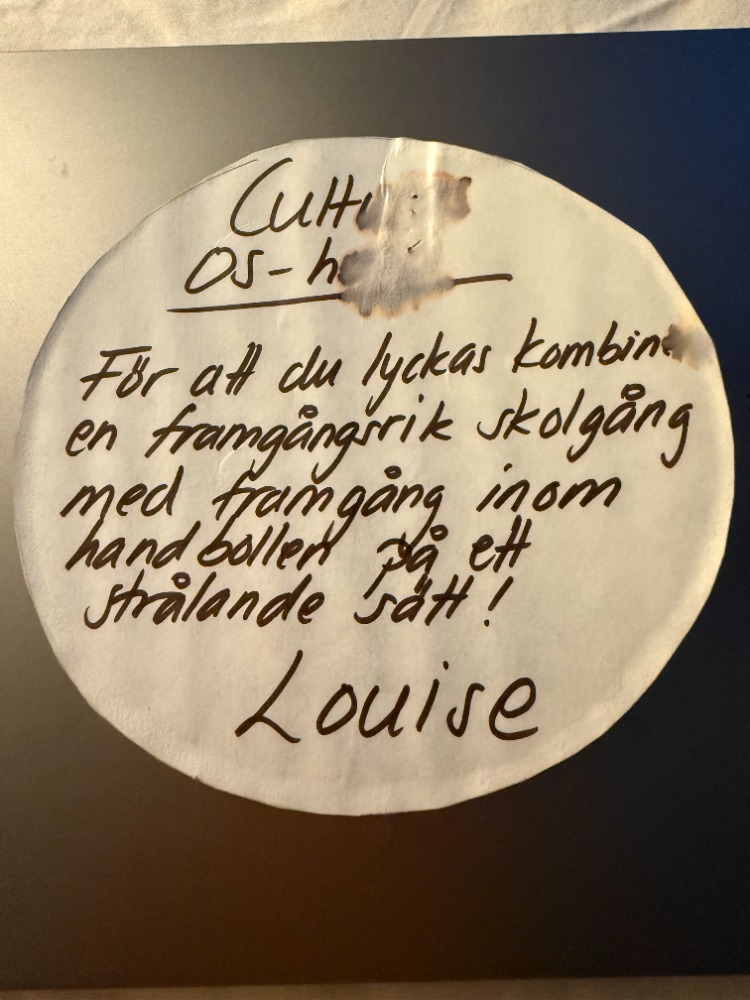
In Sweden, it is common for graduating classes to hand out humorous end-of-year awards. Mine said the following:
“Cultura’s Olympic Hope”
“For successfully combining academic excellence with outstanding achievements in handball”
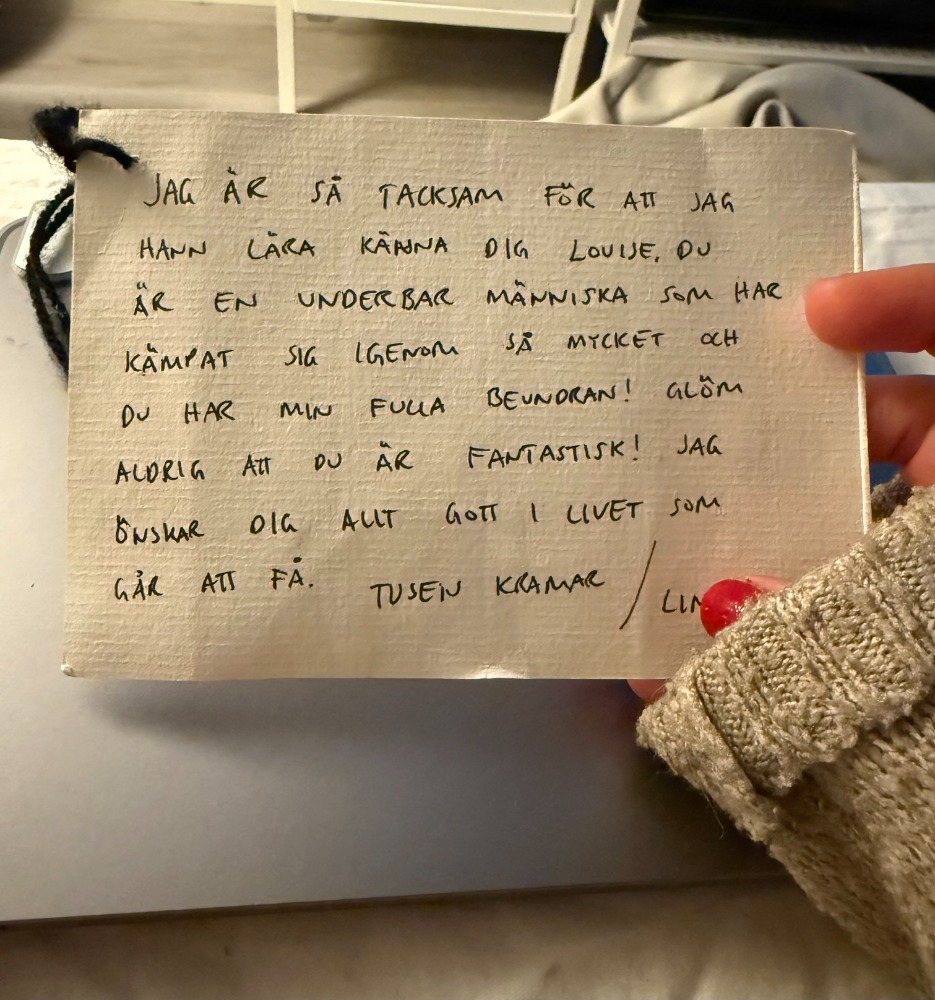
Later, when we left our class to join our friends and family to celebrate our graduation, my former Swedish teacher found me in the crowd. I got the chance to tell her about my success and how much she had meant to me during my final year of high school. Before we parted, she handed me a handwritten letter that read:
“I am so grateful that I got the chance to get to know you, Louise. You are a wonderful person who has overcome so much, and you have my utmost admiration. Never forget how incredible you are. I wish you all the best that life has to offer.”
Little did she know that, when she handed me that letter, I was going to spend a decade fighting for my life. In the worst moments, when the anxiety and fear have been overwhelming, I’ve sought comfort in her words. I’ve kept the letter close to me as a reminder that, no matter what life throws at me, there isn’t anything that I can’t handle. I am not fate’s fool. Just because my path looks different from others’ doesn’t mean it won’t lead to a beautiful destination.
I keep her words with me everywhere I go in life: To always do the best I can given my circumstances. Maybe I am not the most intelligent person on this earth, but no other brain functions the way mine does. Maybe I am not the best singer on this earth, but no one else has a voice like mine. Maybe I am not the best writer on this earth, but no one else can tell my stories.
Everyone is unique, and every path looks different. There is no point in comparing yourself to other people. Since everyone’s circumstances are different, you’ll never get a fair comparison anyway. At the end of the day, it is my belief that we are supposed to complement each other through our differences and help each other grow. Learning is also supposed to be fun and exciting—not a competition.
Just a tiny bit of semantics—it will be interesting, I promise!
I first started law school when I was twenty-two years old. However, I had to take a break after only six months because of my illness. I returned to law school at twenty-five during the pandemic. All the teaching took place online the first three semesters, which was convenient for me. If I needed to rest, I could just go lie down for a bit, and many of the stressful aspects of studying were removed, such as having to catch a train or a bus. I was very excited to start law school. I expected to meet many smart and intelligent people. I looked forward to being in an environment with others who also loved to study and where you could support and learn a lot from each other. And I did. During an advanced course in EU law, there was an exchange student from Norway who was absolutely brilliant. He could argue convincingly from multiple perspectives and was knowledgeable, nuanced, and reflective. It was super interesting to engage in discussions with him.
Yet beneath all that intellectual greatness, two things seemed to permeate law school: envy and competition.
The constant need to diminish others to elevate oneself. The fear of being perceived as stupid. Students thriving on the failures of others. It was common to hear personal attacks or gossip about what other students were wearing. It was also common for previous students to share their notes, and the professors knew about this. Sometimes, they would alter the seminars only slightly—perhaps changing the order of the questions or adding a new one. During one seminar, a student had studied using an older student’s notes and gave the wrong answer when the professor called on him. There were two girls sitting in front of me who looked at each other and made faces. I find it unforgivable. To laugh at someone for giving a wrong answer in a classroom is, in my opinion, immature and mean-spirited. I remember looking at them and thinking:
”Why are people so impressed by top students? Who cares how good your grades are if you are a shit person?”
Good manners will always be more impressive than top grades, since good manners seem to be harder to achieve.
I have so many interesting stories from law school to tell.
What helped me through law school was the fact that I didn’t feel the need to impress anyone. I couldn’t care less whether people thought I was intelligent or stupid. I had my teacher’s words in the back of my head: Do your best given your own circumstances. This is my journey and nobody else’s. I study because I want to learn. I want to understand. I want to evolve. I want to understand myself, other humans, the world, and my place within it.
The meaning of life.
Just teach me. Teach me everything there is to know. I don’t want to be confined by ignorance.
How liberating it is to allow yourself not to know—to be human. To not feel the need to impress anyone or compare yourself to anyone. To just be you. I always ask when I don’t understand. Because it’s okay not to understand things. How will you ever learn if you don’t dare to ask?
I have pondered my own intelligence from every angle—back and forth, up and down, inside and out. I think I’ve reached the conclusion that I am intelligent. That said, the word intelligent is probably far down on the list of the words I’d use to describe myself. If anyone asked me to describe myself, I would use words like rational, reasonable, sensible, philosophical, creative, sympathetic, passionate, perceptive, and diligent. However, all these words could be used to describe an intelligent person. Smart, on the other hand, is not even on the list of words I’d use to describe myself. You see, I am an exceedingly passionate human being, and far too often I listen more to my heart than to my brain. Frankly, my heart walks all over my brain, throws it under the bus, locks it in a closet, and throws away the keys. Why listen to reason when you can get carried away by all the enticing images the heart presents to you? When people find out that I have a master’s in law and have studied several languages, they usually tell me that I am very smart. Whenever people tell me this, I feel like a fraud. I smile at them and think to myself:
“If you had any idea how stupid I am…”
I mean, where do I even begin.
When I was eighteen years old, I was in a period when I was working out like a maniac, and skipping workouts just didn’t exist in my world. One day, I was at the gym doing plyometrics. The workout started rather innocently; I did the normal exercises that most people do: box step-offs, depth drops, squat jumps, skater hops, split squat jumps. Halfway through the workout, I decided that I wanted to try single-leg lateral hops. Even today, I avoid single-leg hop exercises because I am too frightened. I do believe my knee would be able to handle it; I just have insane trust issues and too much trauma. The fifth time I twisted my knee, before I finally had surgery, I was actually at the physiotherapist’s and I had just started to do small jumping exercises on one leg when I twisted my knee again. Even today, I can still relive the pain—the feeling of the lower part of my leg moving in one direction while the upper part moved in another. It’s crazy to think of how much a tiny little ligament inside the knee can affect the stability of the leg. Anyway, I wanted to challenge myself, overcome my fear, and step outside of my comfort zone.
I can barely write what I am about to write—it is so stupid.
What I did next was place a twenty-kilo kettlebell in front of me and begin doing single-leg lateral hops over it. I was in one of those rooms where they would normally have classes, but whenever there weren’t any classes, it was free for members to use however they liked. I wasn’t alone in the room: there were two other people working out there as well. My first jumps were pretty undramatic. But after some jumping, I got tired and I didn’t make it over the kettlebell. I landed directly on top of it and twisted my ankle on the way down. I was lying there on the floor next to the kettlebell, with body parts pointing in all different directions. The pain was excruciating, but I was too ashamed to let it all out. However, there was no way anyone in the room could have missed my very ungraceful fall. Yet no one came up to me to ask if I was alright. Instead, they all acted as if nothing had happened. It was as if I had made a nuisance of myself. As if my very daring method of exercising and my fall had been an inconvenience to them. I couldn’t walk on my twisted ankle, so I wasn’t able to finish my plyometrics workout. But since I never skipped a workout, I hopped on the other leg over to the bicycles and finished my workout with some cardio instead. It is still a mystery to me why, out of all the things in the world I could have jumped over, I thought it was a good idea to jump over a kettlebell. I suppose a jump rope would have sufficed—and probably would have been a lot safer.
When I was twenty, I took an Italian course at Lunds University. On the day of the written examination, I also had a handball game later in the evening. The university was in another city, and I had to take the train afterward to get to the handball game. The examination took place after lunch, and I already knew I would have to leave early to make it to the handball game. But I felt confident and thought that I wouldn’t need the full time anyway, so I didn’t consider it a problem. While I was writing the exam, I found out that it wasn’t just one part—it was divided into three parts. I started to get a little worried that I wasn’t going to make it to the train in time. The clock was ticking, and when I had handed in the second part, I had to leave if I was going to make it to the train in time. If I didn’t write the third part, I wouldn’t pass the exam and if I didn’t, I wouldn’t earn enough credits to get my study grant. That meant I wouldn’t have an income for the rest of my study period that year. It was an important handball game: we were at the top of the standings, and we had to win every game to stay at the top. The other goalkeeper and I took turns starting games, and this was my turn to start. I sat there at the exam and was oscillating between staying and writing the third part or leaving to catch the train. I knew that the right thing and the responsible thing to do was to stay and finish the exam. How was I supposed to survive without my grant? After pondering the situation for a while, I ended up leaving. I thought that, at this very moment, there isn’t anything that is going to stop me from playing the game—whatever financial problems it caused, I would just let my future self deal with them. I had spent too long going back and forth; I had to run to catch the train. However, I still managed to miss it. I called my brother and told him he had to drive me to the handball game, so I took the train to Helsingborg instead and met him there. I arrived just in time for the gathering before the game. But then after the warm-up, when the coach was going to announce who would start, he had decided not to start with me. Afterward he pulled me aside and explained why he had changed his mind: the following weekend, we were going to play a ”top-of-the-table clash”—the first against the second place—and he wanted to start with me in that game instead. I remember thinking: if only he had called me three hours earlier and told me that, he would have saved me so much inconvenience. I spent the whole game on the bench. The worst part is that, my brother had just recovered from food poisoning, but still managed to pass it on to me. Just two days later, I also got sick and couldn’t play the game the following weekend. For a moment, I felt like fate’s fool. Or punished for having listened more to my heart than to my brain. I knew what the right thing to do was, yet I had decided not to do it.
When I was twenty-three years old, I listened a lot to the music of Alan Walker. One day I came across a competition he was running. Participants were supposed to record a cover of one of his new songs. The one who got the most views and likes would then be chosen to sing on stage with him at one of his events. I had never done anything like that before, but I thought this could be my big breakthrough as a singer, so I decided to make a cover of one of his songs. There were just so many challenges for me. I had to ask friends for help with the technical parts. First of all, I didn’t know how to add the background music to the video; I didn’t have any equipment to record with; I had no idea where to start. At the time I was studying literature at university and was surviving on the minimum study grant. I really did believe I had a great chance of winning the competition if I just had the right equipment, so I went to the store and bought an advanced, high-tech Blue Yeti microphone—with the last money in my bank account. I knew it wasn’t the smartest thing to do, since I had no plan B for how to survive the rest of the month. But I thought, you’ve got to risk a little in life to win, right? I thought: “What a story this would be if I actually won.” However, there were two problems. First, I had absolutely no idea how to make the stupid microphone work. I looked at tutorials on YouTube and I had friends trying to help me, but in the end, I had no idea if I even managed to make it work or if there was something wrong with it. The sound wasn’t much different from when I had used the microphone on my iPhone. I recorded a video and entered the competition. The second problem was that I had only two subscribers on my YouTube channel. I was doomed before the competition had even begun. The girl who won had recorded her video in a professional studio with equipment far beyond anything I had access to.
She also had hundreds of thousands of subscribers on her YouTube channel.
How do you compete with that?
Anyway, I had to beg my mom for money to buy food for the rest of the month. When she asked me what I had spent my money on, I told her that it’s best if she didn’t know. That was the only time I ever used the Blue Yeti microphone—assuming I ever figured out how to use it at all. It remains a mystery. I decided to keep it, and now it is standing on one of my shelves in my room as decoration—and as a reminder of how things go when I listen to my heart instead of my brain. But it also reminds me of how much the smallest effort can mean to someone. Whenever I am scrolling on TikTok, and come across a singer who is just sitting at home recording on their phone, I instantly like the video. Because I understand what support can mean to someone—how much a like or a follow can mean to someone who doesn’t have access to the most advanced recording equipment. There is something truly charming and personal about seeing someone share their passion and love for music right from their living room on a mobile phone. It feels so intimate and unpretentious.
These three anecdotes from my own life demonstrate what I mean when I say that I think of myself as intelligent but not smart. In the first anecdote, I was neither intelligent nor smart, since I don’t think it even crossed my mind that jumping over a kettlebell was a terrible idea. In the other two anecdotes, I was intelligent enough to recognize that the decision I was about to make were very stupid and could potentially put me in a tricky position financially. However, knowing that didn’t stop me.
Intelligence refers to our cognitive processes; smartness, on the other hand, lies in our actions—what we decide to do.
A person can be intelligent but not smart. But can a person be smart but not intelligent?
I think so.
Someone can definitely make a smart decision even without being remarkably intelligent. However, I’d argue that smartness is what you choose to do with your intelligence. Are you smart simply because you can speak multiple languages? That depends on why you’ve studied them and what you decide to do with them. It’s not very smart to learn multiple languages if you have no need or plan for how to use them. It’s not necessarily a sign of smartness, since that depends on what you decide to do with the knowledge; however, it could be a sign of intelligence since it does require cognitive ability to learn new ways of thinking and understand the structure of a language—not to mention the grammar rules and memorization of thousands of words. However, language learning is not just an intellectual task; there are other qualities that are required: patience, motivation, and persistence, to mention a few. People who fail to learn a new language as adults don’t necessarily do so because they aren’t intelligent enough; they may simply lack the patience, motivation, or persistence required. I have studied eight languages in total—what does that make me? A genius? I don’t think so. Does that make me smart? Only the future can tell if it was a smart decision or not. So, what does it make me then?
Passionate.
There is only one way to handle that much studying: you have to burn for what you do. I could be a lot smarter than I am and have been. But then I would have to sacrifice my passion, since I do struggle with being both passionate and smart simultaneously. The more passionately I pursue something, the less rational I become. My ardor and fervor—the fire burning inside of me—are the most interesting parts of me. I wouldn’t trade my passion for all the smartness in the world. I love my brain and how it functions. I love the fact that I can point out all the national parks in the US on a map and have intellectual conversations about the riddles of time and space—but also make a complete fool of myself and laugh about it. I can be myself one hundred percent.
Two quotations often attributed to Einstein are “The true sign of intelligence is not knowledge but imagination,” and that “The true measure of intelligence is the ability to change.” I am not going to argue against them. My own observation is that intelligent people adapt to life. They do not spend much time focusing on problems; they search for solutions. They have minds that are constantly searching for new ways to comprehend the world around them. They are not afraid of change, because change is inevitable. Every new step along the way requires a new version of you, but it is up to each individual to decide in what way you want life to change you. Intelligent people understand that life is going to happen to them. Focus must be on what you can control; let go of what you cannot. My observation of smart people, on the other hand, is that they are not necessarily the most knowledgeable ones—the ones who can impress you with trivia. The smartest people are the ones who know how to use their knowledge and intelligence in the most effective way possible to achieve their own goals and meet their own needs.
First picture is of the class award (it was a wet day). The second picture is the letter from my teacher.


Lämna en kommentar