In the documentary Cristiano Ronaldo: Tested to the Limit, researchers examined everything from Ronaldo’s physical abilities to his cognitive performance in an effort to understand what makes him one of the world’s greatest footballers. Successful people have long fascinated researchers across a wide range of disciplines. Psychologists study their personalities and behaviors, neuroscientists study their brains, and sociologists analyze their environments. Despite approaching the question from different angles, they are all trying to answer the same fundamental question:
What drives exceptional achievement?
One of the most influential answers to that question came from the American psychologist Angela Duckworth. Her answer was a single word:
Grit.
The word grit has existed in English for centuries; however, its modern psychological meaning is largely due to the work of Duckworth. She helped transform an ordinary word into one of the most influential concepts in psychology, education, and business during the early twenty-first century. In English, grit originally referred to small particles of sand or stone. From this literal meaning, a metaphorical sense developed:
In its metaphorical sense, someone with grit is tough, determined, and able to keep going despite hardship.
While teaching, Duckworth made a remarkable observation:
The smartest students were not always the most successful. Instead, many of the successful students shared another quality: they simply didn’t quit when things became challenging. This observation inspired her to study perseverance scientifically. Duckworth began studying people in many different settings. She sought to answer one question:
Why do some people continue pursuing difficult goals while others quit?
From this research emerged the modern concept of grit. Duckworth defines it in her TED talk:
“Grit is passion and perseverance for very long-term goals. Grit is having stamina. Grit is sticking with your future, day in, day out, not just for the week, not just for the month, but for years, and working really hard to make that future a reality. Grit is living life like it’s a marathon, not a sprint.”
A person with grit isn’t necessarily the one with the most talent. Instead, it’s a person who keeps going even when things become frustrating, boring, or painful. Someone with grit doesn’t simply work hard—they continue working toward the same long-term objective for years. It’s also worth emphasizing that grit isn’t about never struggling. People with grit frequently doubt themselves, feel frightened, or want to give up. What distinguishes them is that they continue moving forward despite having these feelings.
Although the concept received widespread attention and became highly influential, it also attracted considerable criticism. There are several critiques of grit as a psychological concept. Psychologists disagree about whether grit is a unique, scientifically useful concept and whether it has been overstated. Before Duckworth introduced grit, psychologists had already been studying a personality trait called conscientiousness for decades. Researchers have found that grit overlaps heavily with the personality trait of conscientiousness (being disciplined, organized, persistent, responsible, and hardworking.) Some argue that grit is simply a new label for a trait psychologists have been studying for decades.
The central criticism is therefore:
“Grit isn’t a new discovery—it is largely conscientiousness with a new name.”
If that criticism is justified, then it is debatable how much scientific value the concept of grit actually has. Today, psychologists generally view grit as an important piece of the puzzle rather than presenting the full picture.
The conceptual criticism I find most interesting is not whether grit exists, but whether it is a fundamental trait at all. Another way of looking at it is that grit might simply be the visible result of other psychological forces.
Is Cristiano Ronaldo a successful footballer because he has more grit than others? Or is his grit merely the visible result of a much deeper psychological system? Is his persistence driven by his love for the sport? He finds meaning in what he does. He enjoys mastery. He has a strong identity as a footballer. Or simply by the deep satisfaction he experiences from continually improving?
Is grit really a personality trait—or is it simply the name we give to perseverance once all the deeper psychological pieces have fallen into place?
This is a question psychology has yet to answer definitively.
Grit explains persistence, but does it fully explain motivation? Two people may display identical perseverance, yet the psychological engine driving that perseverance may be completely different. Some people may be driven by extrinsic motivation, such as money, status, praise, or grades. While others may be driven by intrinsic motivation, such as meaning, purpose, love, hope, identity, morals, values, or even fears. Perhaps grit is not the engine. Perhaps it is merely the movement produced by the engine?
Duckworth’s work is primarily concerned with identifying who persists. And the answer to that question is the one who has grit. Or, according to her critics, the one who is conscientious.
The philosophical question that interests me is one level deeper. Why do they persist? Where does the grit come from? What makes a student who keeps failing exams, study harder and eventually graduate? What makes an athlete return to competition after spending years recovering from an injury? What makes a writer continue believing in their manuscript, despite dozens of rejections?
What truly drives gritty people?
What is the foundation upon which grit is built?
Last summer, I spent two weeks driving through Poland—a trip that would change my view of the world forever. Ironically, it was not supposed to happen. The original plan was actually to drive through Germany and break the record for how many national parks it’s possible to visit in two weeks. Just before we were about to start making bookings, my friend said she wanted to join us, but she was going to spend a year in Australia and suggested that we postpone the trip until next summer. I then had to start looking for a new hiking destination. I opened a map of Europe and began searching for another destination. The Dolomites? Jotunheimen? Triglav? Then my eyes drifted a little farther east. The moment I saw the Tatra Mountains, I knew I was meant to go there.
We decided to take the ferry from Karlskrona to Gdynia and then drive through Poland down to Zakopane, which was meant to be our point of departure for our hikes. But since we had a car and it was a long drive, we thought, why not make a few stops along the way? I always get super nerdy when I travel somewhere. I want to learn everything about a destination to make sure I am not missing out on anything. Germany combines two of my favorite things: castles and breathtaking nature. While Germany is famous for its castles, Poland offers something equally captivating: stunning landscapes and a history unlike any other. Although Poland lies just across the Baltic Sea from Sweden, I had never visited it before. While delving deeper into the history of Poland, I realized this trip was going to be more than just indulging in the beauty of the magnificent Tatra Mountains. As I planned the route, I noticed that nearly every place I wanted to visit was connected to the Second World War (WWII). In Gdansk we were going to visit the Museum of the Second World War. In Kraków, Schindler’s Factory Museum and the Jewish ghetto. And after we had hiked for a few days in the mountains, we were going to visit Auschwitz on our way back. Apart from learning about it in school, like any other student, I had deliberately avoided reading about WWII as much as possible. Not because it doesn’t interest me. Quite the opposite. Throughout my studies in diplomacy, international law, and international relations, I’ve read about many different kinds of wars across different eras. But nothing compares to WWII. There is something particularly harrowing about it. Compared with the events of WWII, even the darkest horror story feels almost tame. I am not very fond of horror stories; I prefer to read about things that make me laugh and warm my heart. I don’t like to read about things that make me question the goodness of humanity. Part of me wants to remain in my little Scandinavian bubble—it is far more comforting to believe that altruism and philanthropic desires are humanity’s natural state than to confront the historical events suggesting that this is not always the case.
I wanted to understand what Poland had been through. I wanted to understand the scars and wounds of a nation that was still healing—whose history of suffering few nations can compare with. I was afraid of what immersing myself in a world so far from the one I currently live in would do to me. Perhaps some chapters of human history feel as though they were never meant to be reopened. Perhaps it’s best to just put a big X on the first page and forget about what comes next for the sake of our collective mental health?
But how can we ever truly understand the world we live in if we don’t understand what created it?
What it is built on.
To understand the present, we must understand the past. I decided that to truly understand present-day Poland, I had to understand its past. I must not be afraid to let it change me and my view of the world. Two months before our trip, I ordered a copy of “The Eagle Unbowed: Poland and the Poles in the Second World War,” by Halik Kochanski—a 600-page account of the plight of the Polish people during WWII. Besides reading about it, I also started watching movies about the war. For weeks, nearly all my free time revolved around WWII. If I wasn’t reading, I was watching documentaries or films about it. It had completely consumed me. Some scenes in particular that stayed with me long after the credits rolled were:
In Hacksaw Ridge, Desmond Doss saves not only his fellow soldiers but also decides to spare the life of an enemy soldier. In The Pianist, a Gestapo officer pushes an elderly Jewish man in a wheelchair over a balcony while his helpless family watches. In the first scene of Enemy at the Gates, Soviet soldiers are handed rifles without ammunition, knowing that retreat meant being shot by their own side. The films I watched moved me deeply, but the book was even more poignant—particularly the fourth chapter: “The German and Soviet occupation of Poland to June 1941.” Among the passages that stayed with me, these are a few that I decided to underline. Rather than paraphrase them, I want you to read them exactly as I did:
“Nazi ideology demanded the total subjugation of Poland and erasure of all evidence of her statehood. Heinrich Himmler advocated that ‘all poles will disappear from the world… it is essential that the great German people should consider it as its major task to destroy all Poles’. Frank spoke of the new role of the Poles as ‘the slaves of the Greater German Reich’. Poland was to be plundered and then economically exploited in the service of the Reich. Polish culture was to be erased and Poland turned into an ‘intellectual desert’ with access to education severely restricted”. (p.98)
“The economic exploitation of Poland began with the seizure of Poland’s industrial resources and supply of raw materials. Factories were dismantled, and large quantities of iron and steel, precious metals, chemicals and oil taken to Germany before the end of 1939.” (p.100)
“Rampant inflation robbed the Poles of their savings. Taxes were raised. In January 1940, the Germans even began confiscating warm clothing from the Poles (…) Conditions were worst in the cities where the food supplies were extremely low. Poles were entitled to 609 calories per day, the Jews to 503, in contrast to the Germans, who obtained 2,600. The result was near famine…” (p.100)
“Poles also risked their lives to get food to the starving Jews: A Christian was killed today… for throwing a sack of bread over the wall.” (p.111)
“The basic Polish premise was: We do not beg for freedom, we fight for freedom” (p.204)
“During these dark years the Poles faced a struggle for survival in the face of the racial war against them waged by the Germans. The depredations suffered by and the terror inflicted on the Poles would have been the worse even in the Second World War, except that they were overshadowed by an ever greater catastrophe, the Holocaust.” (p.257)
From the book, I learnt how relentlessly the Poles had to fight for their right to exist in the world. Not only did they have to fight the Germans in the west, but they also had to fight the Soviets in the east. Two superpowers were determined to completely wipe them off the map and use their people as forced labor. Once the Poles were useless to them as forced labor, they were to be exterminated through starvation. The worst part is that this wasn’t the first time someone had tried to wipe Poland off the map. Poland survived the first partition in 1772 but became much smaller. After the second partition 1793, Russia and Prussia took even more territory, and Poland was barely functioning as a state. After the third partition in 1795, Poland disappeared completely from the map. For 123 years, there was no Polish state. When Poland finally regained its independence in 1918, it only lasted for twenty-one years before Germany invaded again in September 1939.
From the book I also learnt the fate of Warsaw, the capital of Poland. By the end of the war, 85% of the city lay in ruins and hundreds of thousands of its inhabitants had been killed. After the Warsaw Uprising, Hitler ordered the city to be completely erased. German forces systematically destroyed churches, museums, palaces, historic monuments, and entire neighborhoods. For example, the Old Town had been almost completely destroyed. It was a deliberate campaign to eliminate the whole Polish capital. Just imagine someone doing that to Paris—Notre-Dame, the Louvre, the Eiffel Tower, Sacré-Cœur, lying in ruins.
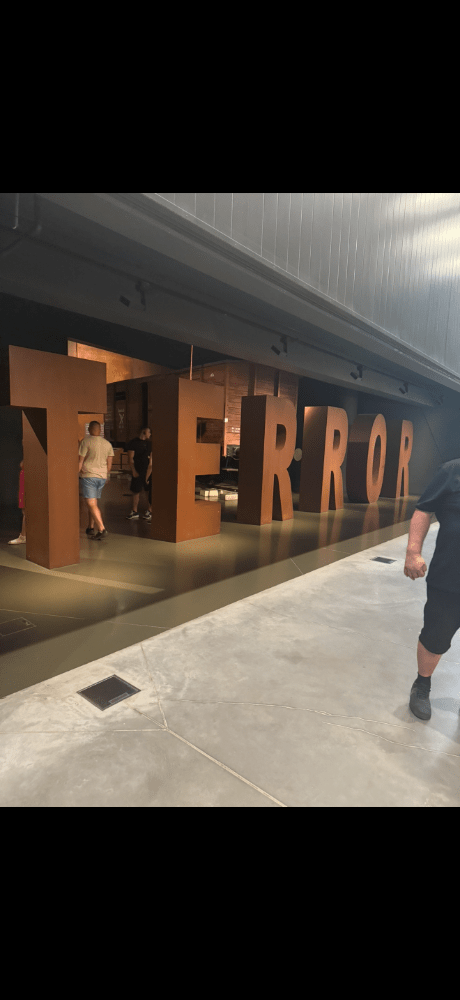
When the day finally came when our trip began, I was physically in the 21st century, but mentally in the 20th century. I wasn’t quite sure what to expect from the trip. It began on a crowded beach in Sopot on a beautiful sunny summer day and ended on one of the most beautiful streets I’ve ever visited in my life—Długi Targ in the center of Gdansk. One of the most remarkable things about Gdansk is that this beautiful city lay in ruins after WWII. However, instead of replacing the Old Town with modern buildings, Polish architects and craftsmen painstakingly reconstructed the city and rebuilt it just the way it looked before the war. It was particularly moving to stand there, watching people dance, sing, paint, and sit outside cafés, knowing everything this place had witnessed—and survived. On the second day, we visited the WWII Museum. Unfortunately, there were too many people for me to fully take it all in. But there was one thing that gave me the chills. The section of the museum devoted to the Holocaust begins with a big sign reading “TERROR.” At least they warn you about what you’re about to experience.
In the afternoon, we took the boat to Westerplatte, the place where WWII began. It was particularly moving, but it also felt a bit peculiar because it was an exceedingly serene place. There was a beach crowded with people enjoying a sunny day. Children were swimming and eating ice cream. Couples walking along the shoreline, holding hands. It was challenging to reconcile that peaceful afternoon with the events that had unfolded on that very shore. Westerplatte holds a special place in the heart of the Polish people because of the extraordinary bravery shown there. Only about 200 Polish soldiers defended Westerplatte. German troops expected an easy victory but were repeatedly driven back by Polish machine-gun fire. Polish soldiers continued fighting despite life-threatening wounds. For seven days, the tiny Polish garrison managed to hold off one of Europe’s most powerful armies. The Polish soldiers defending Westerplatte showed the world that Poland would fight, even when defeat seemed inevitable. To many Poles, Westerplatte represents values such as courage against all odds, loyalty to their country, and the refusal to surrender without a fight.
On the third day, while on our way down to Kraków, we stopped for a few hours to explore Toruń. We also decided to have dinner there, which turned out to be a terrible idea. Because I got food poisoning. While we were on a guided tour of the Schindler’s Factory Museum the following day, I started getting a fever and insane stomach cramps. It ruined the few days we were meant to spend in Kraków; however, the weather was dreadful, so it didn’t ruin too much. When we finally arrived in Zakopane, I had barely eaten for several days. I was too weak to do any hiking for the first two days. On the third day, I told myself that I hadn’t driven all the way through Poland just to miss Morskie Oko—a stunning lake nestled amidst the Tatra Mountains. At six in the morning, we started hiking. The trail to Morskie Oko is quite easy to hike, the problem—at least for someone who had been suffering from food poisoning, and barely eaten for several days—it is uphill the whole way. It took us two hours to get there, but it was worth every step. The way the surrounding mountains were reflected in the lake, together with the clouds drifting just above the water, created an image that was breathtaking to behold. After immersing myself in the horrors of WWII, I needed to remind myself there was still beauty in the world. Unfortunately, we had to cancel all the other hikes we had planned. However, I still got the chance to marvel at the breathtaking beauty of the Tatra Mountains. We had a mountain view from our balcony, and although I was too weak to hike, I could still sit on the balcony and behold the beautiful mountains.
On the penultimate day of our trip, we visited Auschwitz and Birkenau. Historians estimate that approximately 1.1 million people were murdered there. The number is unfathomable. There is one part of visiting Auschwitz that shatters your heart into a million pieces: in one of the rooms, you see the belongings of the people who were murdered. Among all the belongings, you see toys, children’s clothing and shoes. Tiny little shoes that would only fit a two-year-old. Historians estimate that at least 230,000 children and teenagers were deported to Auschwitz. Most of the children were considered too young to work, so they were sent directly to the gas chambers. Hundreds of thousands of children were pushed into gas chambers and gassed to death because the Nazi regime deemed them unworthy of life based simply on the nationality or religion into which they had been born. It wasn’t a life they had chosen; it was simply the life they had been born into, and they were sentenced to death for it.
It is no exaggeration to claim that the events that took place during WWII constitute one of the darkest chapters in human history. Reading about the atrocities humans are capable of committing can make you lose hope in humanity. But the most remarkable thing about WWII is not what happened during it. It is what happened after it.
The end of WWII was a humanitarian, economic, political, and psychological catastrophe. It’s difficult to overstate how devastating the situation was. The humanitarian catastrophe was perhaps the most immediate crisis. Around 85 million people had died worldwide. Millions of widows and orphans. Millions of refugees and displaced people. Widespread hunger and malnutrition. Disease due to poor sanitation and overcrowding. Countless people with lifelong physical and psychological trauma. Many people literally had nowhere to go because their homes no longer existed. Entire cities had been reduced to rubble. Basic infrastructure had collapsed. Many European economies were in ruins. There were food shortages, fuel shortages, unemployment, inflation, destroyed industries, and enormous national debts. Governments faced the enormous task of rebuilding while their tax bases had been devastated. Although the war had ended, people didn’t suddenly feel safe. Many feared another war, Soviet expansion, political instability, famine, and civil unrest. Millions had experienced years of occupation, bombings, imprisonment, torture, starvation, and the loss of loved ones. There was also a moral catastrophe—the Holocaust forced the world to confront a disturbing question:
How could ordinary people participate in extraordinary evil?
The world was shattered. Burned. Starving. Homeless. Traumatized. Unsafe. Humanity had reached the abyss. But although the world had reached the abyss…
They didn’t give up.
They didn’t give up on humanity. They decided to keep fighting for another world, a world they could only imagine. But why didn’t they just give up? Surrounded by darkness on every side, what did they see in humanity worth fighting for? What made them believe there was still beauty in the world worth fighting for? Despite the darkness, they saw light. They imagined a world entirely different from the one they knew and decided to start building toward it.
After two world wars in less than thirty years, world leaders and intellectuals had to ask themselves: how do we make sure there won’t be a third one? How do we make sure this never happens again? How do we build a world that can endure peace?
What followed was one of the most ambitious attempts in human history to construct a more humane world.
In 1945, the United Nations was created. Instead of nations immediately resorting to war, there was now an international forum where world leaders could negotiate, cooperate, and resolve international disputes peacefully. The UN also established agencies focused on children’s welfare, refugees, health, education, and humanitarian aid. Although ideas about human rights had been introduced before the world wars, in the aftermath of WWII they were transformed into an international commitment. One of the most crucial results was the Universal Declaration of Human Rights, proclaiming that every human being possesses fundamental rights simply because they are human. International law increasingly recognized crimes such as genocide and crimes against humanity. Rather than focusing solely on punishing former enemies, they also sought to rebuild devastated economies. Through the Marshall Plan, the US invested billions of dollars in rebuilding Europe. They focused on creating closer international cooperation. There was a growing belief that countries which traded, cooperated, and became economically interconnected would be less likely to resort to war. This thinking contributed to the process of European integration that eventually developed into today’s European Union. They invested in education, hoping that educated populations would be less vulnerable to extremist ideologies. They also focused on building stable societies less vulnerable to political extremism. The world was determined:
The atrocities of WWII were never to happen again.
What happened to Poland? The end of WWII entailed liberation from Nazi Germany; however, it did not bring genuine political independence. Poland entered more than four decades of communist rule under strong Soviet influence. But resistance never disappeared. In 1989, after decades of economic struggle and communist rule, Poland began its transition toward the democratic state it is today. What happened to Warsaw? The story of the capital of Poland is one of the most remarkable stories when it comes to destruction and reconstruction. Instead of replacing the Old Town with new modern buildings, architects reconstructed it using eighteenth-century paintings, old photographs, drawings, and surviving fragments of buildings.
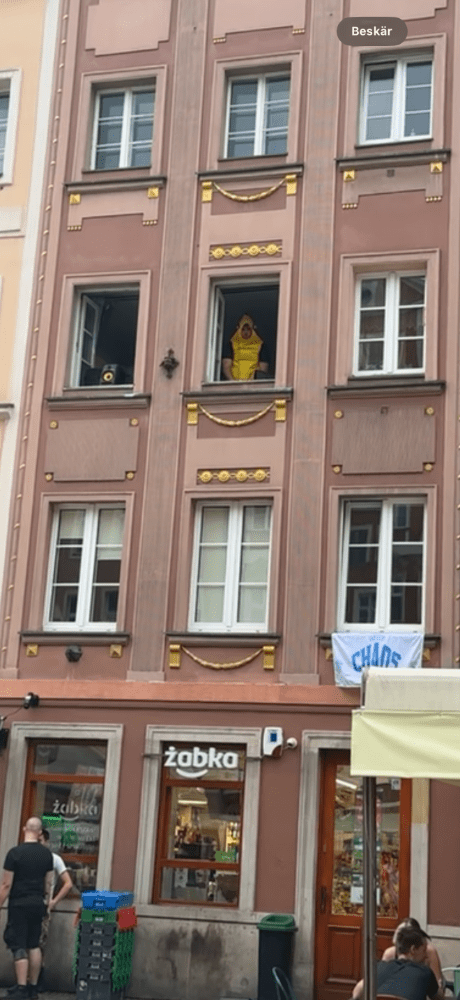
While I was sitting in the beautiful Stare Miasto in Wrocław, I watched people dance and sing. In one of the windows, there was a DJ dressed as a banana playing music to the whole square. I thought to myself: These are the moments the Poles throughout history were fighting for—a free Poland where children and grandchildren could dance and sing to a DJ dressed as a banana. Poland demonstrates to the world that no matter what you have been through, you are never beyond rebuilding. It’s what you choose to do with your experiences that truly matters. And when the world has burned you to the ground and left you shattered into pieces, but you are still breathing, you get to build yourself up again exactly as you choose. Today, Poland is one of the fastest-growing economies in the European Union.
If grit means refusing to surrender your belief in a better future, then few nations embody it more than Poland.
My path to law school is a rather unusual one. After high school I was convinced that the right path for me towards a career in diplomacy was to study international relations. But after my parents’ divorce, when my mother and I moved to the middle of nowhere, my path suddenly took another direction. The bus connections from where we lived were rather precarious. There was a bus that came twice a day—one in the morning and one in the afternoon, if you were lucky. I realized early that if I wanted to be able to leave the house, I was forced to get my driving licence. There was just one problem. I had deliberately avoided it by virtue of my overwhelming fear of vehicles. It wasn’t just the car accident where I almost lost my leg that fueled my anxiety. I once sat in a moving car when one of the wheels fell off. Another very traumatic experience occurred when we were on vacation in South Africa. We had a rental car, and on our way to Hermanus, the tie rod broke, causing a complete loss of steering. My grandfather, who was driving the car, was unable to control it, and we crashed into a ditch. I suppose I have my reasons for not trusting cars. Anyway, I realized that if I wanted to live a life not completely deprived of social interaction, I would have to overcome my fear and, once and for all, get the driving licence.
For my twenty-first birthday, my mom gave me an intensive driving course at the local driving school as a birthday present. It included all the driving lessons and everything I needed to obtain my driving licence in just two weeks. On the first day, the receptionist handed me a stack of papers containing the entire schedule. At the end of the intensive course, after one of my driving lessons, the receptionist handed me another invoice.
5,000 SEK
I stared at it in confusion. I had never agreed to buy another package of lessons. I was a broke university student; I couldn’t afford it. Apparently, I had already completed the intensive package and automatically begun using lessons from another package—one I had never agreed to purchase. Since no one had informed me that my package had ended, I had simply continued attending the lessons that were on my schedule. When I came home, I gave the invoice to my mom. I was anxious about what she was going to say about it. She looked at it and asked me what it was. I told her I had not agreed to it and had no idea that I had finished the intensive package. No one had told me. I wasn’t keeping track of how many driving lessons I had completed because there were so many. She said that there must have been some sort of misunderstanding and that we would go to the driving school the following day and talk to the manager.
To our surprise, the manager showed no interest in resolving the dispute diplomatically. In a condescending tone, she insisted that I was the only one to blame for it all.
She claimed that, on the first day, the receptionist had informed me that an extra driving package had been added to my schedule and that my driving instructor had informed me again once the extra package began. Neither of her claims could have been further from the truth. There were just so many things that didn’t add up. If I supposedly needed extra lessons from the beginning, why wasn’t I informed immediately? Why did they decide to wait until I had already used two of the five extra lessons? Why issue the invoice halfway through the extra package? The manager’s aggressive behavior during the meeting just made it seem even more suspicious. That was when both my mother and I began to suspect that this wasn’t an isolated mistake —it was no misunderstanding. It was calculated. And I was probably not the first client to fall into their trap. We began wondering whether this might have been a deliberate business practice rather than an honest mistake. From our perspective, it appeared that young clients were led to believe they were still using the original package, only to later receive an invoice for lessons they had never agreed to purchase. Most people would probably have paid the invoice and moved on. We couldn’t. It wasn’t about the money anymore: it was about morals and ethics. It had become a matter of principle.
We told the manager that we were not going to pay for the driving lessons we had received as part of the extra package because we had never agreed to them. In our view, no agreement meant no contract. The manager got furious and told us that if we didn’t pay the invoice, she would not lend us a car for my practical driving test. At this point, I was only a couple of days away from my driving test. My mom then explained that refusing to provide the car would constitute a breach of contract, since we had already paid for a final driving lesson and the use of a car for the test. It was hardly the ideal preparation: knowing that I might not even be allowed to take the test made it difficult to prepare mentally. Passing the driving test already felt overwhelming because of everything I had experienced with cars. Now I also had to worry about whether I would even get the opportunity to take the driving test. I asked Mom what we should do, what if she refused to lend us the car? Mom said that we should simply go there anyway. So, on the big day, we went to the driving school for my final lesson before the test. However, they had cancelled the lesson and simply refused to lend us a car.
We walked over to the driving examiner, who was waiting at a nearby parking lot, and explained what had happened. He listened quietly and compassionately. Then he looked at us and said something very unexpected:
“You can use my car.”
Thanks to his offer, I could still go through with the driving test. I still find it hard to believe, but I passed. Even without the extra driving lessons they claimed I needed.
Afterward, the manager sued us for not paying the invoice, and then we sued her for cancelling the final driving lesson and refusing to lend us the car for the driving test. Suddenly, what had started as a disagreement over two driving lessons had become a legal dispute.
When you sue someone in civil court in Sweden, the parties exchange written submissions through the court, explaining their positions in greater detail. What made me fall off my chair was how dishonestly the manager conducted herself throughout the correspondence. One of the things she did was tamper with evidence. Afterwards, she wrote in the notebook—which the instructors filled in after every driving lesson—that, before the first lesson in the extra package, I had been informed that the intensive package had ended, a new package had begun, and that I had consented to it. The addition was written in a different pen and a different handwriting style. I was in complete shock upon seeing the photograph of the notebook: we had a copy of the original. I couldn’t believe someone would stoop so low. It also gave the impression that she was prepared to do whatever it took to win the case. In Sweden there is a legal rule stating that you don’t have to pay for something you did not agree to. Let me give you an example: Imagine your neighbor washes your car while you’re at work, without you ever asking them to. When you return home, they hand you an invoice. Under Swedish law, you generally have no legal obligation to pay simply because someone chose to perform a service you never agreed to. I didn’t know about this legal rule at the time. I could only appeal to morality when arguing why we shouldn’t pay: they had misled me into believing I was still using the original package, and to me, that was an immoral thing to do.
Before a civil case goes to trial in Sweden, the parties usually attend a preliminary hearing with the judge. One of the purposes of the hearing is to determine whether the dispute can be resolved through a settlement instead of a full trial. During the hearing, I witnessed a judge in action for the first time. The manager had made a claim that the judge didn’t fully understand. While his fingers effortlessly leafed through the law book, he turned to her and said:
“What is the legal basis for this claim?”
It seemed as though she had no idea what she was doing. In fact, apart from the judge, probably none of us did. Her claims were nonsensical, and my arguments were purely moral. The impression was that no one in the room knew what they were doing apart from the judge, of course. I was scrutinizing him from head to toe. His charisma, his body language, and his choice of words. He appeared to be so authoritative, sitting there with the lawbook in front of him. Everything about him just screamed power. I decided at that moment that I wanted to study law. The manager at the driving school had made me feel stupid and ignorant. First of all, she had made me feel stupid for not double-checking the stack of papers they had given me. I hadn’t expected to be tricked: I didn’t think people would do that. If I hadn’t been so gullible, I would have discovered right away that something didn’t add up with the number of driving lessons in the schedule. She taught me three things. First, when it comes to businesses, always assume you are going to be tricked. Second, I had not realized what people were prepared to do to save face. Third, it is not enough to just have rights if you don’t know what they are. Knowing your rights—and being able to defend yourself—is power.
And I wanted that power.
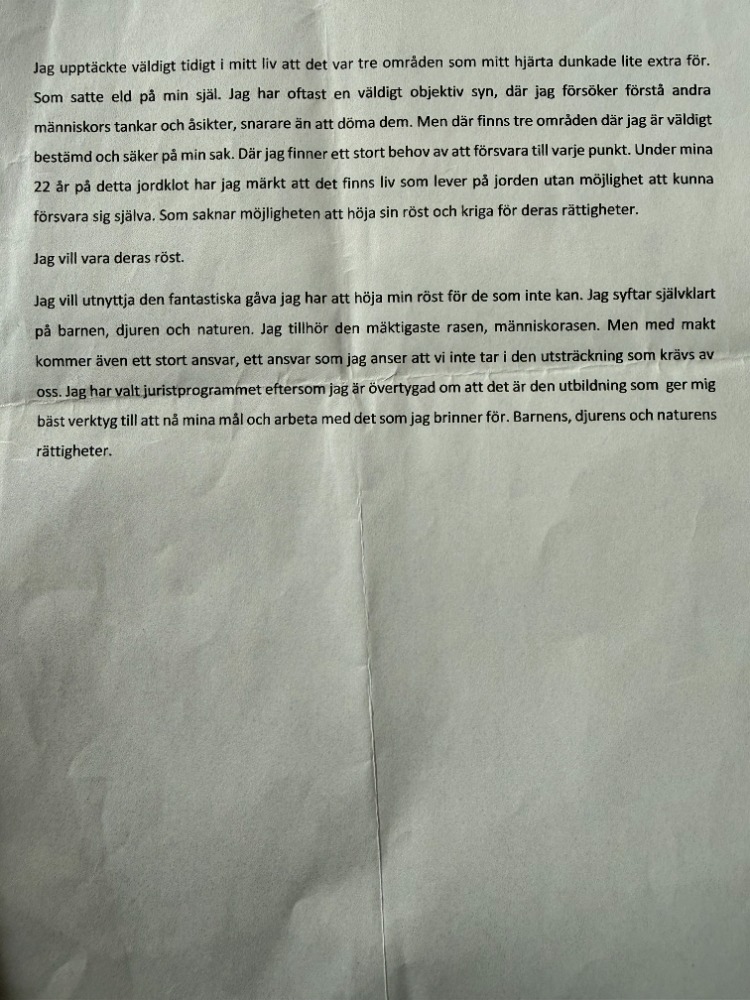
Our very first assignment in law school was to write a paper in which we explained why we had chosen to study law. In my paper, I wrote:
“During my twenty-two years on this earth I have noticed that there are forms of life on this earth without the possibility to defend themselves, that cannot raise their voices and fight for their own rights. I want to be their voice. I want to take advantage of this incredible gift that I have been given, to raise my voice for those who can’t —the children, the animals, and nature.”
The Preamble to the United Nations Charter states:
“We the people of the united nations determined to save succeeding generations from the scourge of war, which twice in our lifetime has brought untold sorrow to mankind, and to reaffirm faith in fundamental human rights, in the dignity and worth of the human person, in the equal rights of men and women and of nations large and small, and to establish conditions under which justice and respect for the obligations arising from treaties and other sources of international law can be maintained, and to promote social progress and better standards of life in larger freedom…”
These words were adopted at the San Francisco Conference in 1945. All the effort they put in after the world wars was not for themselves; it was for us. For their children, their grandchildren, and their great-grandchildren. For you and me, and every generation that follows. They decided to fight for posterity. They lived in a world consumed by hate, racism, fascism, self-destruction, and would soon confront the terrifying reality of nuclear weapons. But instead of continuing lying there among the ruins of that self-destruction, they decided to build. And good things take time to build. They decided that the worst of us don’t get to define us. The darkness within us doesn’t define us. There is beauty and light in the world—things worth fighting for. What was the driving force behind their grit? We will probably never know. Maybe guilt or conscience. Maybe responsibility. Maybe hope and love for this world.
Think of human existence as a book. A book that no single generation will ever finish writing—and each new generation gets to write its own chapter. However, they must continue from the chapter the previous generation wrote. Whatever they write, the next generation has to keep writing from where the previous generation left off. Each new generation gets to shape humanity. They get to leave their mark on the world. We continue writing a story we did not begin, yet we are intimately connected to every chapter that came before us. Their legacy is our present. We did not lay the foundation we are building upon, but we are responsible for what we build on top of it. And one day, today’s world will become a future generation’s foundation. But now it’s our time to shape the world: to leave our mark on the world. To create the foundation the next generation will build on. And we must ask ourselves:
What do we want to be remembered for?
Nothing breaks my heart more than knowing that, despite everything humanity has tried to build since WWII, we have not yet managed to save succeeding generations from the scourge of war. Children are still being killed by bombing and shelling. Children are still being orphaned by war. There are still children who never return to school. According to UNICEF, children make up a large proportion of the world’s displaced people. Many children spend years living in refugee camps or temporary housing. Many children experience deep psychological trauma that they carry with them for the rest of their lives. In some conflicts, children even become soldiers.
Children don’t start wars; they don’t vote for governments that start wars, yet they often suffer some of the greatest consequences. They are the ones paying the highest price for the conflicts created by adults.
I have always felt that I belong to this world, and this world belongs to me. I have always felt a responsibility to do good in it, and to not squander my talents. Now it is my time to shape the world. I have a video saved on my phone of a young boy living in a war zone. He’s being interviewed by a reporter who asks him what he dreams of. He tells the reporter that he dreams of owning a car like Ronaldo’s and believes he can make that dream come true because he is a good football player. In moments when I want to give up, I look at the video and I remind myself why I fight—for him. And I must not let him down. If the only thing standing between me and my goal is hard work, then I must work harder than hard to make sure that our children grow up in a world where they can prosper, learn and develop in safety. Where their fundamental human needs are satisfied. Where they can chase their dreams instead of fearing the sky. I’ll learn every language there is and study every course—whatever it takes to make that world a reality and not just a vision.
When I took the ferry from Poland back home to Sweden, I stood there in the harbor and marveled at the enormous ship. I thought to myself, “How crazy is it that this giant thing doesn’t sink?” And that humans built this thing? How many brilliant minds had to come together to build something like this? We forget how incredible we are. How ingenious, talented, creative, and diligent we are. But then I also thought, “If we have the capacity to create airplanes, artificial intelligence, spacecraft, sophisticated legal systems, we also have the capacity to protect our children.”
We can turn war zones into dance floors with DJs dressed as bananas.
We can create a world where children aren’t buried beneath bombs.


Lämna ett svar