A few days ago, I had a friend read my latest post: “What drives me.” When I asked what she thought about it, she only had one question in her mind:
“What about the women?”
“What do you mean?”
“What about the women’s rights?”
Then she began telling me about the plight of women around the world. The little girl who dreams of becoming a doctor but does not have the legal right to education. The little girl who is forced to marry an older man she has never met. The wife who cannot divorce her husband even though he beats her whenever the local football club loses a game, or when he had one or two too many drinks in the evening: because she will lose custody of the children, or because she is afraid he will beat her to death if he finds out she wants a divorce. Or maybe because she can’t support herself financially—so she is forced to stay. The woman who is forced into prostitution to make a living. The woman who must give birth to her rapist’s child because she does not have the legal right to abortion. The woman who dreams of building her dream home but does not have the legal right to own property. The woman who cannot uncover her hair in public because she fears being imprisoned if she does. She finished by asking me the question:
Aren’t you a feminist?
Frankly, I’ve never liked that word, probably because I associate it with angry women and misandry, and any kind of hate makes me deeply uncomfortable. I dread people asking me this question particularly for two reasons. First, the term is so broad, I wouldn’t know what I was saying yes or no to: Am I a liberal feminist? A radical one? An existential one? Feminism has become a deeply charged word, used in many different contexts. Before I answer, I need to know what the questioner means by it. I need some sort of conceptual clarity before I can accept or reject a label. Second, the question reminds me of how startlingly ignorant I am when it comes to the ideology of feminism. It also reminds me of how little attention I have paid to feminist thought. I don’t think you can blame me for it: I don’t live in the world my friend describes. Frankly, I’d feel terribly hypocritical to sit here and pretend that I have any idea what it’s like to live in a society where women are seen and treated so inhumanely when it is so far from the one I live in. I can only imagine what it must be like, but I can never truly know. But just because I cannot tell their stories doesn’t mean that I cannot fight for their human rights.
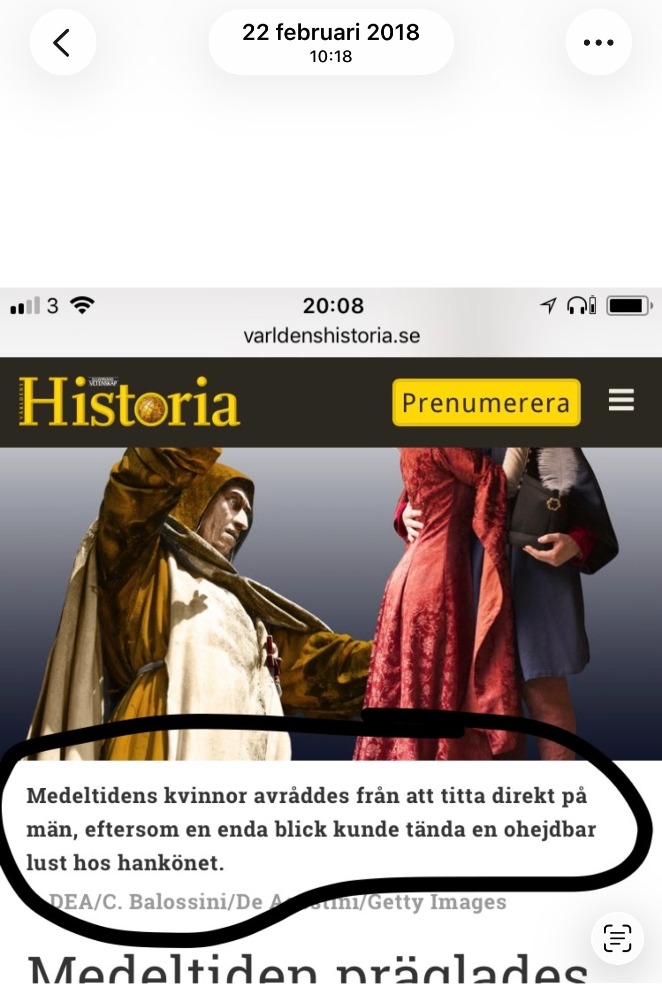
Although I have never experienced it myself, the plight of women—both today and throughout history—has never passed me by. In my early twenties, I spent a lot of my free time doing research for my fantasy novel. Creating an entirely new world is a far more complex intellectual task than most people imagine. The most important question to investigate was this: ”What shapes our view of the world?” and ”What creates our assumptions, beliefs and prejudices?” One way for me to approach these questions is by looking at them from a historical perspective: to compare our modern world with previous civilizations that have called this earth its home as well. Hence, I spent a lot of time reading about prehistory and antiquity, with the aim of understanding their worldview: to better understand the complexity of the world that I have created inside my head. While I was searching through historical sources, I constantly encountered articles that immediately caught my attention because of how ludicrous I found them. One article explained how women in the Middle Ages were discouraged from looking directly at men because a single glance was believed to awaken an irresistible desire in men. I found it striking how the responsibility for men’s sexual desire was placed on women’s behavior. As I continued reading, I came across another article explaining the circumstances under which women were granted the right to education in Sweden. While reading the article, I learnt that during the eighteenth-century many believed it was inappropriate for women to be educated since the only thing a woman needed to know was how to take care of the home and obey her husband. Fathers and male educators were the ones who primarily decided what daughters should be taught. They came to realize that providing girls with a better education could be beneficial to:
Men.
The subject sparked a debate. Some argued that too much knowledge was harmful to the “delicate female intellect.” There were fears that learning would make girls frivolous or flighty. Eventually, people agreed that girls needed better education. One argument was that educated women would make more pleasing marriage partners. It was considered better for men to have an educated wife because home life would be more pleasant if a husband could discuss different subjects with his wife. The goal of girls’ education became to prepare them to become good wives, competent mothers and capable homemakers. Women were to be educated in order to make men’s lives easier. Women’s education was not viewed as an end in itself, but as a means of making life more comfortable for men.
One thing struck me as I read these articles. Although they were discussing women’s issues—they were never from a woman’s perspective. They were never really about women.
Few years ago, when I was living in Stockholm, I was going to take the train back home for the Easter holiday. It was going to be a five-hour long train ride, and I had just completed an exam, so I no longer had any coursework to study. Before leaving campus, I decided to stop by the campus bookstore to see if I could find anything interesting to read on the train. While my eyes wandered across the shelves of philosophy literature, there was one book in particular that caught my attention. There she was: the mother of feminist philosophy:
Mary Wollstonecraft.
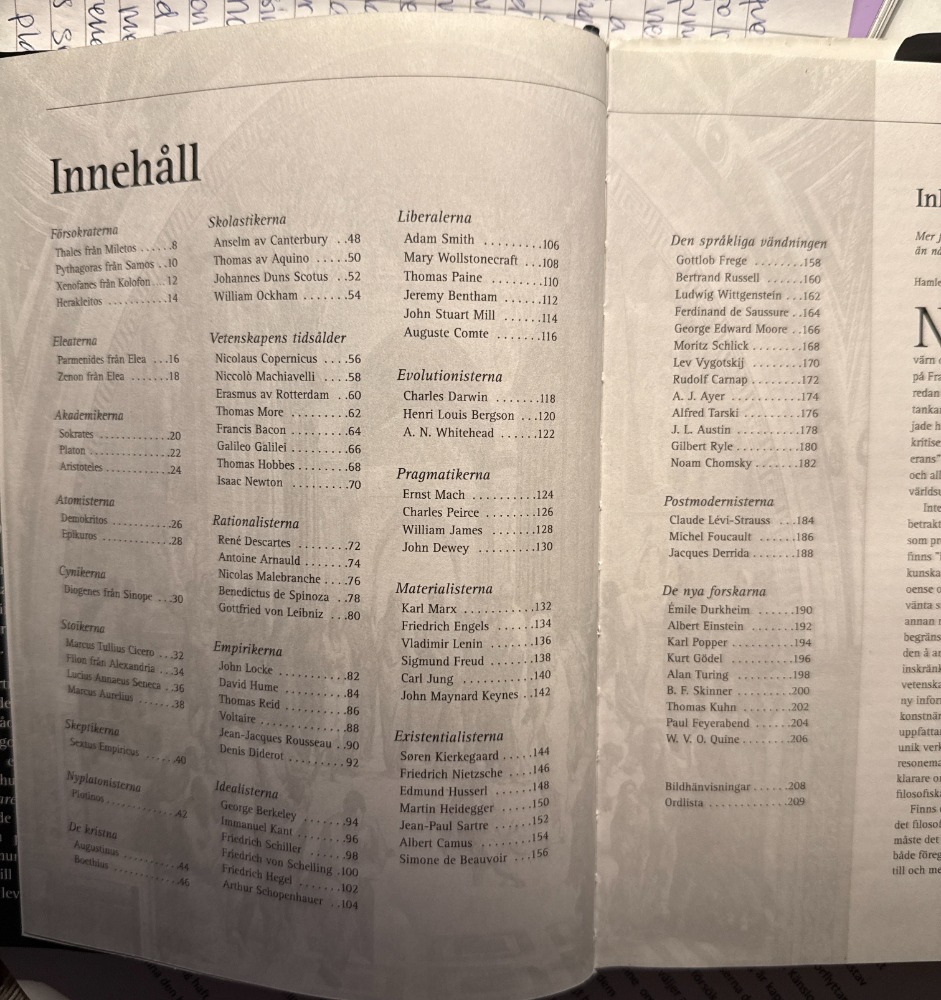
It was not the first time her name had crossed my path. Some years earlier, I had bought a book containing one hundred of history’s greatest thinkers. When I opened the book, there was one thing that immediately caught my attention: out of hundred names, only two of them were women. Simone de Beauvoir and Mary Wollstonecraft. I immediately wondered what could possibly be the cause of this? Did women not think? Did they not share their thoughts? Did no one listen to them? Did women not publish their writings? Were they overlooked? Perhaps they did publish writings but under the name of a man? Did they not have time to think because they were busy doing chores? Were women simply uninterested in philosophy, or were they interested but excluded from it? If that were the case, that women were excluded from intellectual disciplines, how come a woman such as Mary Wollstonecraft, who came from a poor family and in a time where girls did not have the right to education, managed to make it on to a list so dominated by men? What was so special about her? Seeing her name on the book on the shelf made me think that, maybe it was time for me to find out what was so special about Mary Wollstonecraft, so I bought it.
After I had finished the book, it was perfectly clear to me why she was one of only two women who managed to make it on to a list of the greatest thinkers of all time—she was truly an extraordinary philosopher who just happened to be a woman. A woman with a brilliant mind. I will now attempt to explain what made her such an extraordinary philosopher. But before I can explain what she wrote, we must first understand why she wrote it.
In 1790, Edmund Burke published “Reflections on the Revolution in France.” He defended tradition, monarchy, inherited privilege, and the aristocracy. Wollstonecraft responded with “A vindication of the Rights of Men,” defending liberty and equality. Then in 1792, another philosopher entered the discussion: Charles Maurice de Talleyrand-Périgord. He argued that women should receive only enough education to fulfill their domestic roles. Talleyrand was not the first philosopher to argue about how women should be educated. In 1762, one of the Enlightenments greatest thinkers, Jean-Jacques Rousseau, published his influential Émile, or “On education.” In the book, Rousseau introduced Sophie, the ideal woman. He argued that her education should differ from Émile’s because her only purpose is to complement and please her future husband. Although Wollstonecraft returned to Rousseau’s writings throughout the book, it seems to have been Talleyrand’s work that became the immediate catalyst for her “A vindication of the rights of woman.” Throughout the book she argued with philosophers such as Rousseau, John Milton, Dr. Gregory, Fordyce, because she believed they all made the same fundamental mistake. In essence, they were all asking the same question:
“How should women be educated to become more pleasing to men?”
Wollstonecraft had another question that occupied her thoughts:
“If women possess rational, immortal souls, why are they educated as though they do not?”
That question changed everything.
Philosophy is not about finding the right answers: It’s about finding the right questions. It is almost as if Wollstonecraft walked fearlessly into intellectual rooms which she had never been invited to because she was a woman, asked someone to hold her cup of tea while she explained to the gentlemen just how unreasonable—and how unphilosophical—their questions really were. Instead of asking how women should be educated to become more pleasing to men, what they should be asking is:
“What kind of education allows women to become fully rational and virtuous human beings?”
In “A Vindication of the Rights of Woman,” Wollstonecraft argues that society treats women as though they lacked fully rational souls. The soul is closely connected with our rational and moral nature. She believed that what distinguishes human beings from animals is our ability to reason, make moral judgements, cultivate virtue, and pursue truth. If society deliberately prevents women from exercising those capacities, it is treating them as if they were something less than fully human. It was her belief that society was keeping women in intellectual childhood. Children aren’t expected to reason independently; they obey because adults tell them to. Humans possess dignity because they possess reason. Therefore, to deny someone the opportunity to cultivate their reason, is to deny one of the most fundamental aspects of their humanity. Human dignity requires that every person be free to cultivate their reason. To deny women education, it’s not just withholding knowledge; it is to withhold the opportunity to cultivate reason. Human dignity belongs to every person simply because they are human. Wollstonecraft didn’t define humanity solely by intelligence, she defined it by the capacity for improvement. What makes us human is not simply the possession of reason, but the ability to cultivate it throughout life. If people cannot exercise reason freely: people cannot become virtuous. Without virtue, they cannot fully flourish as human beings.
Women are fully rational human beings. Therefore, they deserve the same dignity and moral respect as men.
This is Mary Wollstonecraft’s central claim. But let’s return to her central question:
“If women possess rational souls, why are they educated as if they do not?”
Page ten of the book is my favorite page. There is so much happening on just one page. She is addressing John Milton, the author of Paradise lost (1667) which retells the biblical account of Adam and Eve. In Paradise Lost, Milton describes Eve as being created for: beauty, softness, grace, obedience. While Adam was associated with reason, authority, and intellect. Wollstonecraft writes that Milton describes women as “formed for softness and sweet attractive grace.” She cannot make sense of this unless he means to deprive women of their souls. She is reasoning like this:
If women exist only to be beautiful, obedient, and attractive, then they cannot simultaneously possess the same kind of rational soul as men. Throughout the Enlightenment, the soul was understood as the source of reason, morality, virtue, and free will. If women are never expected to exercise reason, then society is effectively treating them as though they have no rational soul—they are not fully human.
On the same page, Wollstonecraft also writes, “Men, indeed, appear to me to act in a very unphilosophical manner, when they try to secure good conduct of women by attempting to keep them always in a state of childhood.”
I mean, to think of and treat women in this way is hardly virtuous, is it? Doesn’t that say more about men’s intellectual capacity than it says about women’s? However, Wollstonecraft does not call men evil; she calls them unphilosophical. She argues that their reasoning is inconsistent. Wollstonecraft demonstrates impressive courage and confidence on this page. First, she dared to criticize religion, that takes courage even in modern days. Second, she wasn’t afraid to challenge the intellectual giants of her age. This is truly remarkable. She wasn’t merely highlighting how women were treated as slaves: deprived of souls. She was entering the philosophical conversation demanding to be treated as an equal. She was not afraid of accusing men of bad philosophy. Another striking feature of her book is that every argument she advances is grounded in reason rather than emotion.
Wollstonecraft argued that women were not naturally intellectually inferior; rather, society denied them education and then mistook the consequences of that denial as evidence of natural inferiority.
Society created inequality and then mistook it for nature.
Wollstonecraft didn’t think women were naturally less rational than men. Instead, she argued that society had produced women who appeared less rational. Her argument was roughly this: Men observed that many women seemed less educated, more emotional, preoccupied with beauty, pleasing men, and less interested in intellectual disciplines, such as, philosophy or politics. Many men then concluded:
“Women are naturally intellectually inferior.”
Wollstonecraft argues that men confused the consequences of unequal education with evidence of natural inferiority. When women and men were compared, society was not comparing two groups that had enjoyed equal opportunities to develop their minds. Wollstonecraft believed women had been harmed because society encouraged dependence rather than intellectual development. Men were mistaken because they interpreted socially produced dependence as proof of natural inferiority. Wollstonecraft acknowledged that women could appear intellectually inferior—but she insisted that appearance was the consequence of unequal education and social expectations, not of biology.
Wollstonecraft challenged whether people had correctly identified the cause of what they observed: She challenged the premise that women were naturally intellectually inferior.
Although Wollstonecraft does attribute responsibility to men and holds them responsible for many of the norms she criticizes, she does not portray men as uniformly malicious or hateful. She argues that men have inherited and perpetuated a flawed system—one that they may benefit from in some ways, but that ultimately diminishes everyone. On page 92 she writes that, “Men are not aware of the misery they cause, and the vicious weakness they cherish, by only inciting women to render themselves pleasing;” Her reasoning can be reconstructed like this:
Men encourage women to prioritize beauty and pleasing men: Women respond to those incentives and neglect the cultivation of reason and virtue.
Subsequently, men mistake the unintended consequences of their own incentives for evidence of women’s nature.
On page 36, Wollstonecraft writes the following:
“I love man as my fellow; but his sceptre, real or usurped, extends not to me, unless the reason of an individual demands my homage: and even then, the submission is to reason, and not to man.”
Wollstonecraft was not advocating misandry; she was opposing arbitrary authority. Her allegiance was to reason, not to either sex. She didn’t perceive women’s struggle for equality as a battle of women against men, she saw it as a project of moral and intellectual reform.
Wollstonecraft criticized what society had turned women into. Society encouraged women to develop beauty instead of reason. The blame lay not in women’s or men’s biology but in society. Wollstonecraft rejected the idea that men should be rational and courageous and women merely beautiful and obedient. Instead, she argued that both women and men should strive for reason, integrity, moral courage, and genuine interdependence. She believed that when women are denied education, everyone loses. Women lose their intellectual and moral development, and men end up with marriages lacking in genuine companionship because they encouraged qualities that don’t foster lasting affection. When women are educated only to please, men lose the opportunity to have intellectual companions, moral equals, and genuine friendship within marriage. Her vision isn’t one sex triumphing over the other; it’s a society in which both become wiser, more virtuous, and more fully human through mutual improvement.
This is why Wollstonecraft criticizes society’s excessive focus on women’s beauty. If a woman is educated to ask:
“How can I become more attractive?”
Instead of asking:
“How can I become more virtuous?”
Then in Wollstonecraft’s eyes, society has failed her.
Wollstonecraft believed that both men and women had moral duties:
Men had a duty to stop treating women as ornaments. And women had a duty to cultivate their intellect instead of embracing the role society assigned them.
You read that correctly. Women did not get off that easily.
Wollstonecraft argued that women appeared intellectually inferior because they lacked equal educational opportunities to develop their minds. She believed that if women had equal opportunities and were free to cultivate their minds, reason would increasingly replace superficial ideas. She imagined a society where women received the same education as men, women who cultivated their reason, women who became morally independent, and marriages that became a partnership rather than a relationship of dependence. A society that placed no limits on how much a woman could cultivate her mind.
But then she writes something intriguing:
“If then women do not resign the arbitrary power of beauty—they will prove that they have less mind than man.”
In essence, Wollstonecraft is saying that once society becomes more rational and equal, women also bear a responsibility. If women continue to rely primarily on beauty, flirtation, or social influence instead of cultivating their minds, then they cannot blame society. Once equal opportunities exist, Wollstonecraft expected women to choose reason over superficial advantages. She expected women to choose reason over beauty.
Wollstonecraft acknowledges that her vision of society seemed unrealistic to many of her contemporaries. Remarkably, her vision resembles many aspects of the modern Nordic countries where women receive the same education as men, the same access to universities, the right to own properties, political rights, legal rights, women with careers in every profession, women who marry for companionship rather than for dependence and financial stability. Women who have the right to divorce if they’re not pleased.
Now almost 240 years after Wollstonecraft wrote her “Vindication of the Rights of Woman,” many of the barriers Wollstonecraft fought against have been removed in the Nordic countries, the question is: Are women still less educated? Still considered more emotional than rational? Still preoccupied with beauty and pleasing men although there are other ways to subsist? Are women less interested in intellectual disciplines? This is perhaps the greatest test of Wollstonecraft’s philosophy. If women truly possess the same intellectual capacity as men, then societies that have removed legal and educational barriers should reveal it:
Was Wollstonecraft right that once women had access to the same education as men, women would participate equally in intellectual disciplines?
Women were taught to value beauty over reason because society rewarded them for it. Now that women have the opportunity to cultivate both, which quality does society reward more: beauty or intellectual achievement?
In the Nordic countries women generally make up more than half of all university students, and they also earn more bachelor’s and master’s degrees than men. In many fields, women are now the majority of graduates. This is something I have experienced myself. In my year at law school, around 70 % of the students were women. If it continues like this, there is a risk that in the future the majority of the judicial system will be made up of women—lawyers, judges, prosecutors. In politics, the Nordic countries have among the world’s highest levels of female participation in parliament, government, and public administration. Interestingly, philosophy remains one of the more male-dominated humanities. Women are still underrepresented among philosophy professors and academic philosophers. However, women have become judges, physicians, professors, scientists, lawyers, politicians, authors, and scholars in enormous numbers. The Nordic countries provide strong evidence that women participate in intellectual disciplines once they have been given the opportunity—however, there are many ways of interpreting the true meaning behind “equally.”
The second question is far more difficult to answer. The arbitrary power of beauty still has its grip on the world. One example is the expression “pretty privilege,” which emerged in online discourse during the early 2010s before gaining widespread popularity on social media. It refers to the idea that people who are considered conventionally attractive tend to receive societal advantages because of their appearance, often without anyone consciously realizing it. The concept of “pretty privilege” relates to a well-established psychological phenomenon called the “halo effect” —a cognitive bias in which one positive characteristic causes us to assume that a person has other positive characteristics as well—although there is no evidence for those assumptions. For example, studies have shown that attractive defendants may sometimes receive more favorable judgements or lighter sentences for certain offenses: not because judges intentionally favor attractive people—it is often an unconscious bias. Wollstonecraft referred to beauty as possessing an “arbitrary power.” If beauty is indeed a form of power—and if it gives women social advantages over men—wouldn’t it be understandable that some women choose to make use of it? Wollstonecraft’s description of beauty as an “arbitrary power” raises another philosophical question. If beauty is largely an unearned gift of nature, is its power rooted more deeply in biology than in social arrangements?
Throughout the book, Wollstonecraft keeps returning to the soul because, to her, the soul is the seat of reason and moral development. Society prevents women’s souls from fulfilling their proper function: to exercise reason. The soul possesses reason; through reason, the soul cultivates virtue, through virtue, a person fulfills their humanity. That is why education matters so much to her. It’s not simply about acquiring knowledge: It’s about allowing the soul to fulfill its purpose. Every time she mentions the soul, it makes me think about a poem by Edith Södergran that I came across while I was studying literature. Although it was eight years ago, this poem still resonates with me:
Du sökte en blomma You sought a flower
Och fann en frukt And found a fruit
Du sökte en källa You sought a spring
Och fann ett hav And found an ocean
Du sökte en kvinna You sought a woman
Och fann en själ— And found a soul—
Du är besviken. You are disappointed.
I interpreted the poem as suggesting that the disappointment occurred not because the woman lacked something, but because she possessed something that was not requested, something he was not interested in, something he was not in search of. He wasn’t searching for a soul: merely something that pleased his eyes. Perhaps the man saw beauty and obedience, but when he found an autonomous inner life, intellect, individuality, dreams, goals, visions, charisma, a soul—he was disappointed because that was not what he was seeking.
Why did reading Wollstonecraft make me remember this poem? Because both question whether women are recognized as fully human beings in the eyes of society.
I do not live in the same world as Mary Wollstonecraft, nor the same world as Edith Södergran. In the time and part of the world in which I live in, men do no longer perceive women as intellectually inferior, and men are not disappointed when they find out that women do not exist merely to please men—in fact women are fully rational human beings who possess a soul.
How nice and comfortable it is to have these assumptions. Like Wollstonecraft writes, a once perceived utopia now turned into a reality.
Or?
In 2016 something remarkably happened. Hillary Rodham Clinton, a woman, ran for president of the world’s most powerful nation. One recurring question in the media was whether the United States was prepared to elect its first female president. That one thing that caught my attention was the rhetoric used against her: why she was not suitable as a commander-in-chief. She wasn’t just fighting against assumptions that her resumé and politics made her unsuitable; she was also fighting against the assumptions that she wasn’t suitable because she was a woman. Some commentators argued that women might be too emotional or too influenced by hormones to handle the job. Perhaps some would argue that the reason Clinton wasn’t successful in her attempt of becoming the first female president was because of her political positions and the controversies surrounding her. Perhaps others would argue that the United States just wasn’t ready for a female president. Eight years later, Kamala Harris, another woman, made her own attempt of becoming the first female president. During one of the debates following the election, Harris’ opponent blurted out that he should be elected for president because he was better looking than her. He also made comments about her being slow and having low IQ. I couldn’t help but imagine how I would have responded in a similar situation. If I ever decide to run for prime minister in Sweden and my political opponent would suddenly blurt out that he would be a much better choice for the job because he is better looking than me, I would probably question whether he was mentally fit for the job or I’d be too shocked that I would assume that I was being pranked. Whether these stereotypes changed the outcome of the elections is a separate question. What interested me was that such arguments still appeared at all.
Last year, I turned thirty years old. After spending almost a decade of my life fighting against a life-threatening disease, I celebrated my thirtieth birthday being fully healthy again. A victory against all odds. Many people experience the “quarter-life crisis” where they ask themselves questions such as “am I behind everyone else?”, “Am I in the right career?”, “Should I be in a relationship by now”, “Maybe own my own house?” I didn’t ask myself any of these questions. Although I was single, broke, and still living at home—perhaps a failure in many people’s eyes—from my perspective, I was genuinely so happy just to be alive and able to celebrate my thirtieth birthday. There were moments when that didn’t feel like a certainty. After turning thirty, there were those who told me that I must hurry now and find myself a partner because soon nobody is going to want me—as if I had an expiration date. At first, I found it a bit amusing: the fact that, no matter how bad it had been, I had refused to give up on my future—just to have people tell me that I was soon about to expire in the eyes of society anyway. But after hearing it several times it became less amusing each time. And it made me truly ponder what it implies: it is not my mind that is expiring—quite the opposite. Although most people would probably argue that the idea of women having an “expiration date” is an outdated social construct, I cannot help but wonder whether it truly is.
When Joanne Rowling submitted the first Harry Potter manuscript, her publisher Bloomsbury, was concerned that young boys would be less likely to pick up a fantasy novel if they saw that it had been written by a woman. Hence, they advised her not to publish under “Joanne Rowling,” instead, to use initials. The problem was that she didn’t have a middle name, so she chose “K” in honor of her paternal grandmother “Kathleen” and became J.K Rowling. The author of the best-selling book series of all time and the fastest-selling books, was suggested to not have her female name published because boys were perceived as less willing to read books by female authors. What does this actually imply? If the publisher’s concern was justified, then the issue wasn’t Rowling’s ability to write—it was the reader’s assumptions about who has the capacity to write fantasy.
Few months ago, one of Sweden’s biggest female influencers who has now decided to turn to politics, made a statement that caused a lot of critique amongst the Swedish population. She claimed that women did not understand how a government is constructed and it was important to make women understand how a government functions. Many people perceived it as being denigrating towards women and women’s intellectual capacity. In response to the criticism, she argued that women tend to vote more according to their values, while men tend to focus more on specific policy issues. It felt a bit anachronistic. Although it couldn’t have been more contemporary, it almost felt as if I had stepped into a time machine and traveled back 200 years to when society viewed women as emotionally driven and men the reasonable ones.
For centuries, society believed women were intellectually inferior. Today, almost nobody explicitly says so. But has the perception truly changed—or has it merely changed its form? Has it become less visible and subtler?
And perhaps even more importantly: How could we ever know?
Today, women are represented in virtually every profession and contribute seminal work across intellectual disciplines. Since Wollstonecraft’s time, the world has been transformed by figures such as Marie Curie, Emmeline Pankhurst, Ada Lovelace, Rosalind Franklin, Jane Austen, Emmy Noether, Lise Meitner, Joanne Rowling, Barbara McClintock, Rachel Carson, Hannah Arendt: extraordinary women whose ideas, discoveries, and achievements left an enduring intellectual mark on the world. Yet, it’s almost as if parts of society still aren’t entirely convinced. The assumptions of women’s intellectual inferiority, the unconscious biases, the prejudices, they still linger, hiding in the shadows, and every now and then they pop out into the spotlight and remind us that they still exist in some corners of society. Wollstonecraft fought for women’s legal and educational recognition. Perhaps the struggle today is no longer primarily against discriminatory laws, but against the prejudices and unconscious assumptions that can continue to shape society and how people perceive one another.
If women’s extraordinary intellectual achievements didn’t manage to change society’s implicit view of women’s intellectual capacity, then what are women truly up against? Wollstonecraft argued that women appeared intellectually inferior because they were denied education, independence, and opportunities to develop their reason. Under this view, society’s beliefs of women’s intellectual capacity were transmitted culturally, children learned them from previous generations, and then social institutions reinforced them. If certain beliefs persist across generations, what explains their persistence? If those beliefs appear across many cultures and generations, is it the product of culture, biology, or perhaps both? Where do our beliefs truly come from? Perhaps Wollstonecraft was wrong when she put the blame on society, but maybe she was right when she investigated its origins. But if some assumptions persist long after the laws and institutions that once supported them have changed—yet the unconscious belief did not change with them—then maybe society’s view of women’s intellectual inferiority is far more deeply rooted than the social institutions that originally reinforced it. To answer this question, perhaps one must look at what Wollstonecraft’s society and modern society still have in common.
If these assumptions about women’s intellectual capacity can survive although the changes that have been made and the brilliant female minds the world has produced, maybe it doesn’t matter how much women educate themselves and cultivate their minds: it doesn’t matter what they achieve—the biases are so unconscious, profoundly rooted.
Perhaps the more important question is not whether society’s perception of women’s intellectual capacity has changed or not: but how can we ever know whether they have, if unconscious biases still linger after the laws have changed and it is no longer socially acceptable to overtly display such assumptions.
Perhaps the more important question is not whether society’s perception has changed, but how we could ever know whether it has. Laws can change, institutions can change, and public language can change—but changing minds is something else entirely.
Can we ever truly know what another person believes?
If men feel much safer having a man perform surgery on them, or if they think they have better chances of winning a case if a man lawyer is defending them in court, if they trust research made by a man more than a woman, or if they think ruling a country is a man’s job and not a woman’s: we can never truly know. And whatever answer there is to this question, perhaps it’s better if we just don’t know.
Maybe some questions are better left unanswered.
Wollstonecraft was fighting something that was visible. What if women of my generation is fighting something invisible?
Can we ever truly be equal before unconscious biases have disappeared? And is the only way for women to truly make them disappear, to give up the arbitrary power of beauty and focus entirely on cultivating reason?
The deepest insight in Wollstonecraft’s work is not her political philosophy: its her moral philosophy:
If women should obtain education to become better housewives, then the access to education is still justified for the sake of men, not for the sake of women as rational human beings. Women should not have equal educational opportunities because its beneficial to men; women should have equal opportunities because they possess inherent dignity. A human being should never be treated merely as a means to someone else’s ends.
I find it truly remarkable that a philosopher can have a “radical” mind-blowing idea or insight and then two hundred years later that idea becomes a self-evident truth—a fundamental pillar in a modern society. Recently I’ve asked multiple women if they know who Mary Wollstonecraft was—and I’m surprised by how many women don’t know who she was. I follow up by asking if they believe women should have the right to education. Most women find this question rather absurd—it’s a self-evident truth to them. Any rational human being must think so? But do they know why they think this way? Why do they say these words? Do they know who first said them? Do they know who shaped their prejudices, their assumptions, their unconscious biases and beliefs? Would they regard women’s right to education as a self-evident truth if Mary Wollstonecraft had never argued for it over two centuries ago?
Perhaps the only way to fight the invisible is for each member of society to find the courage to ask themselves: where do my unconscious beliefs originate? Are these truly my own thoughts or did someone else plant them in me? Who is it, and what is it that truly shapes my view of the world?


Lämna ett svar